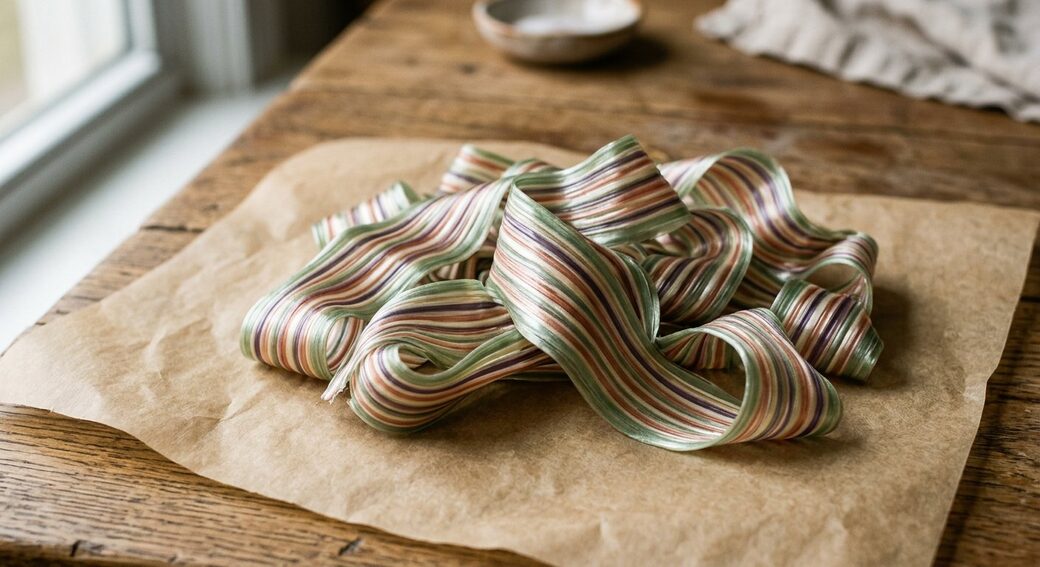
Think about the difference between a block of clear lake ice and fresh wind-packed snow, or between a calm sheet of sea glass and white ocean foam. Chemically, nothing was added—the only change is millions of tiny air-to-surface boundaries bouncing incoming light back to your eye.
Traditional open-kettle candy making uses that exact optical principle to build extraordinary visual contrast inside a single batch.
What Happens During Sixty Pulls on the Wall Hook
When a batch cools on our marble slab to roughly 205°F, it reaches the consistency of stiff, warm taffy. If we leave a portion untouched and cast it directly into brass frames—as we do for Tessera Prism Pops—light travels straight through the solid sugar glass with crisp jewel-like refraction.
When we lift another portion onto our heavy steel wall hook, stretch it three feet out, loop it back over the hook, and repeat that rhythm sixty times, each fold traps a thin pocket of air and stretches that pocket into thousands of parallel microscopic tubes running lengthwise down the rope.
- After 15 pulls: Clear amber turns slightly hazy and opalescent.
- After 35 pulls: Deep ruby shifts into soft antique rose; dark caramel gleams like brushed copper wire.
- After 60 pulls: Untinted clear sugar transforms into luminous pearl-ivory satin that catches window light like woven silk ribbon.
How Pulling Secretly Shapes Our Flavor Twists
The magic isn’t purely visual. Surface area governs how fast aroma and taste register on your tongue.
Solid unpulled sugar glass is dense and non-porous, dissolving slowly and steadily from the outside in. Hand-pulled satin sugar, by contrast, is riddled with microscopic air capillaries. As soon as a pulled core meets warm saliva, those tiny channels open up all at once—releasing flavor faster, softer, and warmer than the clear glass shell around it.
That difference in dissolve speed is one of our favorite tools when designing a Bellglass flavor puzzle. By wrapping a dense, slow-melting outer jacket around a briskly blooming pulled satin core—as we do in Solstice Horizon Drops—we can time the second flavor note to arrive right when you think you have figured the candy out.